Remote Alcohol Monitoring: How It Works and Your Options
Remote alcohol monitoring has changed dramatically in recent years.
What used to mean bulky ankle bracelets and expensive monitoring services now includes sleek portable devices, smartphone apps, and flexible testing options that put you in control. Whether you need monitoring for court, custody, recovery support, or family accountability, there's likely an option that fits your situation and budget.
This guide explains how remote alcohol monitoring works, compares the main options available, and helps you choose the right approach for your needs.
What Is Remote Alcohol Monitoring?
Remote alcohol monitoring is any system that verifies sobriety and shares results with another party—without requiring in-person supervision for every test.
The "remote" part means results are transmitted electronically to whoever needs to see them: a court, probation officer, attorney, treatment provider, employer, or family member. This creates accountability without requiring someone to physically watch you take every test.
Remote monitoring systems typically include:
- A testing device (breathalyzer, ankle bracelet, or collection kit)
- Identity verification (photo, video, facial recognition, or biometric confirmation)
- Result transmission (automatic upload to an app, monitoring center, or designated recipients)
- Documentation (timestamped records that can be used as evidence)
Who Uses Remote Alcohol Monitoring?
Remote monitoring serves many different needs:
- Courts and probation: Monitoring sobriety as a condition of probation, bond, or diversion programs
- Family law: Documenting sobriety during custody disputes or as part of parenting agreements
- Treatment programs: Continuing accountability after rehab or during outpatient treatment
- Sober living facilities: Verifying resident compliance with house rules
- Employers: Monitoring employees in safety-sensitive positions or return-to-duty programs
- Families: Rebuilding trust after alcohol-related problems, with results shared between family members
The best monitoring option depends on your specific situation, who needs to see the results, and what level of verification they require.
Types of Remote Alcohol Monitoring
1. Portable Breathalyzers with App Connectivity
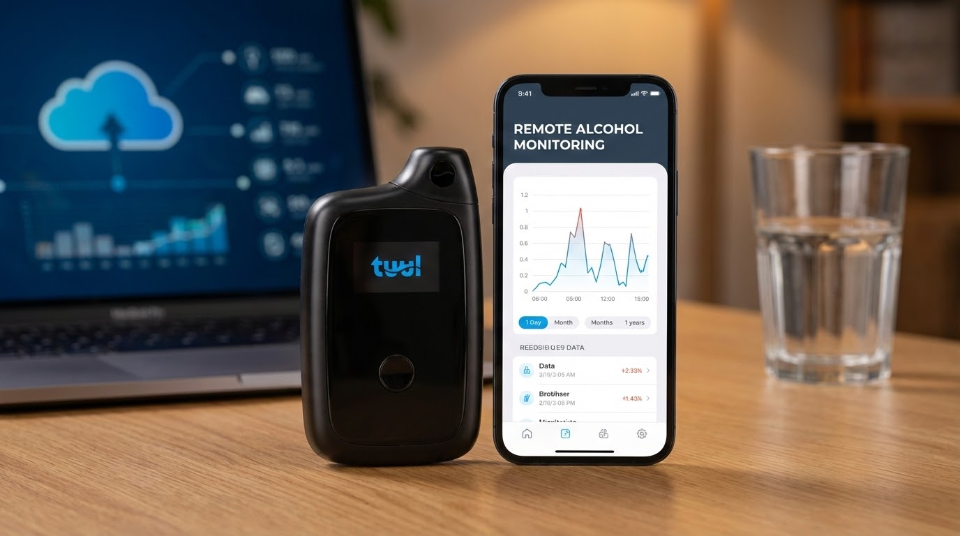
How it works: You blow into a handheld device that measures breath alcohol content. The device connects to a smartphone app that logs results with timestamps, photos, and sometimes GPS location. Results can be automatically shared with designated recipients.
Testing frequency: Flexible—you set the schedule based on your needs. Common schedules include twice daily, before/after specific events, or random times.
Cost: One-time device purchase. No ongoing monthly monitoring fees with most personal devices.
Verification features:
- Photo capture during test confirms identity
- Timestamp and date logging
- GPS location (on some devices)
- Automatic result sharing with family, attorneys, or others
Best for: Custody cases, family accountability, voluntary recovery support, probation (where accepted), and situations where you want control over your monitoring.
Pros: Discreet, portable, affordable, no monthly fees, you control the device. Feels supportive rather than punitive.
Cons: Requires you to initiate each test (not passive monitoring). Shorter detection window than continuous monitoring.
2. Continuous Ankle Monitoring Bracelets
How it works: An ankle bracelet worn 24/7 measures alcohol in your sweat (transdermal testing) every 30 minutes. Results transmit automatically to a monitoring center, which reports to the court or supervising authority.
Testing frequency: Continuous—automatic testing every 30 minutes around the clock.
Cost: $300-400+ per month, plus installation and removal fees. Often paid by the person being monitored.
Verification features:
- Tamper detection alerts
- Continuous automatic testing
- Professional monitoring center oversight
Best for: Court-ordered monitoring for high-risk DUI cases, serious probation violations, or situations requiring the highest level of verification.
Pros: Most comprehensive monitoring available. Universally accepted by courts. No action required from wearer.
Cons: Expensive, visible, stigmatizing. Must be worn during sleep, exercise, and bathing. Can cause skin irritation. Usually court-ordered rather than voluntary.
3. Scheduled Remote Testing Services
How it works: A monitoring company provides a portable breathalyzer device and requires tests at scheduled or random times. Tests typically include facial recognition or video verification. Results go to a monitoring center that reports to courts or other authorities.
Testing frequency: Set by the monitoring company or court order—typically 2-4 times daily at scheduled or random times.
Cost: $150-300+ per month for monitoring service, plus possible device fees.
Verification features:
- Facial recognition confirms identity
- Randomized test times prevent gaming
- Professional monitoring and court reporting
Best for: Court-ordered monitoring where ankle bracelets aren't required, probation compliance, professional licensing requirements.
Pros: More discreet than ankle monitors. Accepted by many courts. Professional documentation.
Cons: Ongoing monthly fees similar to ankle monitors. Less flexibility than personal devices. Miss a scheduled test and it counts against you.
Comparing Remote Monitoring Options
|
Feature |
Portable Breathalyzer |
Ankle Monitor |
Testing Service |
|
Monthly Cost |
$0 (one-time buy) |
$300-400+ |
$150-300+ |
|
Discretion |
High |
Low |
Medium |
|
Testing Type |
On-demand |
Continuous |
Scheduled/random |
|
Court Acceptance |
Growing |
Universal |
High |
|
Who Controls It |
You |
Monitoring company |
Monitoring company |
|
Best For |
Custody, family, voluntary |
High-risk court orders |
Probation, licensing |
What to Look for in a Remote Monitoring Solution
When choosing a remote monitoring option, consider these factors:
- Accuracy: For breathalyzers, fuel cell sensors provide professional-grade accuracy. Avoid cheaper semiconductor sensors, which are less reliable.
- Verification strength: Photo verification is good; video is better. Facial recognition adds another layer. Consider what level of verification your situation requires.
- Result sharing: Can results be automatically sent to the people who need to see them? Look for easy sharing with family members, attorneys, or courts.
- Documentation quality: Clear records with timestamps, dates, and verification data are essential if results might be used in court.
- Total cost: Compare one-time costs vs. monthly fees. A $200-300 breathalyzer with no monthly fees costs far less over 6-12 months than services charging $200+/month.
- Acceptance: If you need court acceptance, verify your chosen method meets local requirements. Ask your attorney what's accepted in your jurisdiction.
Choosing the Right Option for Your Situation
If you need monitoring for family or relationship accountability:
A portable breathalyzer with result-sharing is usually the best fit. It's affordable, discreet, and lets you prove sobriety to family members without involving outside companies. The key is consistency—testing regularly and sharing results builds trust over time.
If you need monitoring for a custody case:
Portable breathalyzers with verification features are increasingly accepted in family court. They're less invasive than ankle monitors and demonstrate proactive accountability. Talk to your attorney about what your specific court requires—proactive testing before it's ordered often makes a strong impression.
If you're on probation or have a court order:
Check your specific requirements carefully. Some orders mandate ankle monitoring; others allow alternatives. If you have flexibility, a portable breathalyzer or testing service may cost less than ankle monitoring while meeting your compliance needs. Ask your attorney or probation officer about options.
If you want monitoring for personal recovery support:
Choose the option that feels supportive rather than punitive. For most people, this means a personal breathalyzer you control—something that helps you stay accountable to your goals without feeling like surveillance.
The Bottom Line
Remote alcohol monitoring doesn't have to mean ankle bracelets and expensive monthly fees.
Modern portable breathalyzers with smartphone connectivity offer a dignified, affordable alternative for many situations. They put you in control while still providing the verification and documentation that courts, families, or employers need to see.
The right choice depends on your specific requirements. For court-ordered monitoring, verify what's acceptable in your jurisdiction. For family accountability or personal recovery, a portable device with result-sharing features often provides the perfect balance of accountability and autonomy.
|
Looking for Remote Alcohol Monitoring? The tuul® Breeze is a professional-grade portable breathalyzer with smartphone connectivity, photo verification, and automatic result sharing. Monitor your sobriety remotely—without monthly fees or ankle bracelets. |
Frequently Asked Questions
What is remote alcohol monitoring?
Remote alcohol monitoring is any system that verifies sobriety and transmits results electronically to courts, probation officers, family members, or others—without requiring in-person supervision for each test. Options include portable breathalyzers with apps, ankle monitoring bracelets, and scheduled testing services.
How much does remote alcohol monitoring cost?
Costs vary widely. Portable breathalyzers with app connectivity require a one-time purchase with no monthly fees. Ankle monitoring typically costs $300-400+ per month. Scheduled testing services run $150-300+ per month. Over 6-12 months, a personal breathalyzer often costs a fraction of monitored services.
Is portable breathalyzer monitoring accepted by courts?
Increasingly yes, especially in family court and custody cases. Acceptance varies by jurisdiction and judge. Devices with verification features (photo, timestamp, result sharing) carry more weight. Check with your attorney about what's accepted in your specific court.
Can I switch from an ankle monitor to a portable breathalyzer?
If your ankle monitor was court-ordered, you'll need to petition the court to change monitoring methods. Your attorney may be able to argue for a portable breathalyzer alternative based on compliance history, cost hardship, or other factors. Success depends on your specific situation and jurisdiction.
How accurate are portable breathalyzers for remote monitoring?
Professional-grade portable breathalyzers using fuel cell sensor technology offer accuracy comparable to devices used by law enforcement. For monitoring purposes, choose a device with fuel cell sensors rather than cheaper semiconductor sensors, which are less reliable.