How Accurate Are Breathalyzers? What You Need to Know
If you're considering a breathalyzer for personal use, recovery support, or professional monitoring, accuracy is probably your biggest concern.
Can you actually trust the number on the screen? Will a portable device give you reliable results? What's the difference between a $30 breathalyzer and a $300 one?
This guide cuts through the confusion and explains exactly how breathalyzer accuracy works—including the technology behind it, what affects results, and how to choose a device you can trust.
The Short Answer: It Depends on the Technology
Breathalyzer accuracy varies dramatically based on the type of sensor inside the device:
- Fuel cell breathalyzers are highly accurate—typically within ±0.005% BAC of actual blood alcohol levels. This is the same technology used by law enforcement and professional monitoring programs.
- Semiconductor breathalyzers are far less accurate—often off by 0.01-0.02% BAC or more. They can also produce false positives from substances other than alcohol.
The price difference between these technologies explains why you'll see breathalyzers ranging from $20 to $400+. You're not just paying for a brand name—you're paying for fundamentally different accuracy.
How Breathalyzers Measure Alcohol
When you drink alcohol, it's absorbed into your bloodstream and eventually reaches your lungs. As blood passes through the tiny air sacs in your lungs, some alcohol evaporates into the air you exhale.
A breathalyzer measures the concentration of alcohol in that exhaled breath and uses it to estimate your blood alcohol content (BAC). The legal limit for driving in most states is 0.08% BAC.
But how the device detects that alcohol makes all the difference in accuracy.
Fuel Cell Sensors: The Gold Standard
How they work: Fuel cell sensors use an electrochemical reaction to detect alcohol. When alcohol molecules contact the sensor, they undergo oxidation, producing an electrical current. The strength of that current directly corresponds to the amount of alcohol present.
Why they're accurate: Fuel cells are highly specific to ethyl alcohol (the kind in drinks). They don't react significantly to other substances in your breath, which means fewer false positives and more reliable readings.
Typical accuracy: ±0.005% BAC or better. Professional-grade fuel cell devices often achieve ±0.001% accuracy.
Who uses them: Law enforcement agencies, court-ordered monitoring programs, workplace testing, treatment facilities, and anyone who needs results they can trust.
Cost: $150-400+ for quality personal/professional devices.
Semiconductor Sensors: The Budget Option
How they work: Semiconductor sensors use a metal oxide that changes electrical resistance when it contacts alcohol vapor. The device measures this resistance change to estimate BAC.
Why they're less accurate: Semiconductor sensors aren't specific to alcohol. They react to many volatile compounds—including acetone (from diabetics or people on keto diets), cigarette smoke, and various chemicals. This means they can show a reading even when no alcohol is present.
Typical accuracy: ±0.01-0.02% BAC or worse. Results can vary significantly between tests.
Who uses them: Budget-conscious consumers who want a general indication rather than precise measurement.
Cost: $15-50 for most consumer devices.
Fuel Cell vs. Semiconductor: Quick Comparison
|
Factor |
Fuel Cell |
Semiconductor |
|
Accuracy |
±0.005% BAC or better |
±0.01-0.02% BAC |
|
Alcohol-Specific |
Yes |
No |
|
False Positives |
Rare |
Common |
|
Sensor Lifespan |
3-5+ years |
6-12 months |
|
Price Range |
$150-400+ |
$15-50 |
|
Used By Law Enforcement |
Yes |
No |
|
Best For |
Professional, legal, recovery |
General curiosity only |
What Affects Breathalyzer Accuracy?
Even with the best technology, several factors can influence your reading:
Timing of the Test
Alcohol takes time to absorb. If you test immediately after drinking, your BAC is still rising. Wait at least 15-20 minutes after your last drink for a more accurate reading. For the most accurate results, wait until you've stopped drinking completely and your BAC has peaked (usually 30-90 minutes after your last drink).
Mouth Alcohol
Residual alcohol in your mouth from recent drinking, mouthwash, or breath spray can cause falsely high readings. Most quality breathalyzers require a waiting period of 15-20 minutes after eating, drinking, or using oral products.
Proper Technique
Breathalyzers need a deep lung air sample—not just a puff. Blow steadily with moderate force until the device indicates the sample is complete (usually 3-5 seconds). Weak or short breaths can produce inaccurate readings.
Calibration
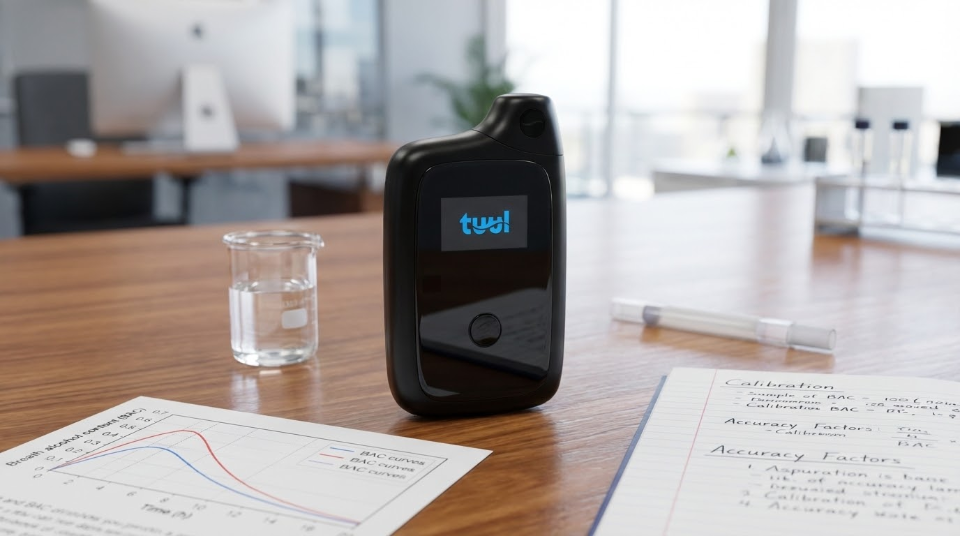
All breathalyzers need periodic calibration to maintain accuracy. Professional devices typically need calibration every 6-12 months or after a certain number of tests. Uncalibrated devices drift over time and become unreliable.
Temperature
Extreme temperatures can affect sensor performance. Most devices work best between 50-104°F (10-40°C). If your device has been in a very hot or cold car, let it adjust to room temperature before testing.
Individual Variation
Body temperature, breathing patterns, and even certain medical conditions can cause minor variations in readings. This is why professional testing protocols often require multiple tests.
Why Accuracy Matters for Your Situation
For Recovery and Sobriety Monitoring
If you're using a breathalyzer to verify sobriety for court, custody, probation, or family accountability, accuracy isn't optional. A false positive could have serious consequences. A false negative could put you or others at risk. Invest in fuel cell technology.
For "Am I Safe to Drive?" Decisions
Never rely solely on a breathalyzer to decide if you're safe to drive—especially a semiconductor device. Even accurate readings don't account for impairment that occurs below the legal limit. But if you want a reality check, a fuel cell device will give you much more reliable information than a cheap semiconductor.
For Casual Curiosity
If you just want a rough idea of where you stand after a few drinks—with no serious decisions riding on it—a semiconductor device might be adequate. Just understand its limitations and don't treat the number as precise.
How to Get the Most Accurate Results
- Choose a fuel cell breathalyzer. This is the single biggest factor in accuracy.
- Wait 15-20 minutes after eating, drinking anything (including water), smoking, or using mouthwash.
- Blow properly. Take a deep breath and blow steadily until the device signals completion.
- Keep your device calibrated. Follow the manufacturer's calibration schedule.
- Test multiple times. If a reading seems off, wait a minute and test again. Consistent results across multiple tests are more reliable.
- Store properly. Keep your device in a cool, dry place away from extreme temperatures.
The Bottom Line
Breathalyzer accuracy comes down to one thing: the sensor technology inside.
Fuel cell breathalyzers are highly accurate (±0.005% BAC) and specific to alcohol. They're the same technology used by law enforcement and professional monitoring programs. If accuracy matters for your situation—recovery support, legal compliance, custody cases, or professional monitoring—fuel cell is the only choice.
Semiconductor breathalyzers are cheaper but significantly less accurate. They can produce false positives from non-alcohol substances and aren't reliable enough for any situation where results matter.
The extra investment in fuel cell technology is worth it for anyone who needs results they can trust.
|
Looking for an Accurate Portable Breathalyzer? The tuul® Breeze uses professional-grade fuel cell sensor technology for accurate results you can trust. Compact, discreet design with smartphone connectivity for result logging and verification. |
Frequently Asked Questions
How accurate are personal breathalyzers?
Personal breathalyzers with fuel cell sensors are highly accurate—typically within ±0.005% BAC. Semiconductor breathalyzers are much less accurate, often off by ±0.01-0.02% or more. The technology matters more than the price tag.
Are cheap breathalyzers accurate?
Most cheap breathalyzers (under $50) use semiconductor sensors, which are not very accurate. They can show false positives from non-alcohol substances and results vary significantly between tests. For reliable results, invest in a fuel cell breathalyzer.
Can a breathalyzer give a false positive?
Yes, especially semiconductor breathalyzers. They can react to acetone (from diabetes or keto diets), mouthwash, breath spray, cigarette smoke, and other substances. Fuel cell breathalyzers are alcohol-specific and rarely produce false positives.
How long after drinking can a breathalyzer detect alcohol?
Breathalyzers detect alcohol while it's still in your system—typically 12-24 hours after heavy drinking, though lighter drinking clears faster. For precise timing, alcohol is metabolized at roughly 0.015% BAC per hour for most people.
Do I need to calibrate my breathalyzer?
Yes. All breathalyzers need periodic calibration to maintain accuracy—typically every 6-12 months or after a certain number of tests. Check your device's manual for specific requirements. Using an uncalibrated breathalyzer will produce unreliable results.