BAC Calculator: How to Estimate Your Blood Alcohol Level
You've had a few drinks and you're wondering: what's my blood alcohol content right now? Am I safe to drive? How long until I'm sober?
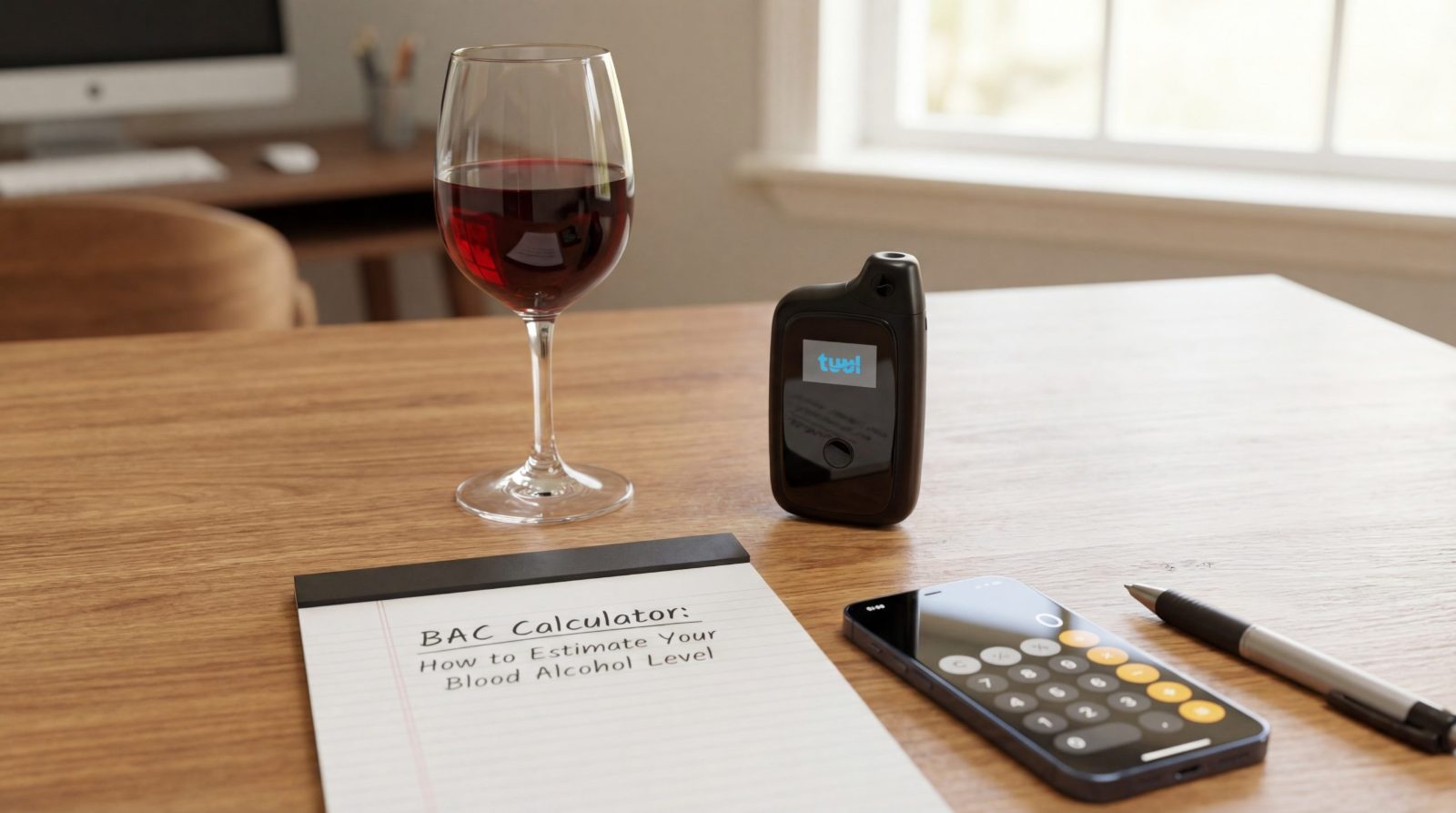
BAC calculators attempt to answer these questions using formulas that estimate your blood alcohol level based on factors like weight, gender, number of drinks, and time elapsed. They're useful for general awareness—but they come with significant limitations you need to understand.
This guide explains how BAC calculations work, what factors affect your actual BAC, and why estimates should never replace actual measurement when making important decisions.
What Is BAC?
BAC stands for Blood Alcohol Content (or Blood Alcohol Concentration). It measures the amount of alcohol in your bloodstream as a percentage of total blood volume.
For example, a BAC of 0.08% means there are 0.08 grams of alcohol per 100 milliliters of blood. This is the legal driving limit in all 50 U.S. states—though impairment begins at much lower levels.
Here's what different BAC levels typically mean:
BAC Level | Typical Effects |
0.02-0.03% | Slight mood elevation, mild relaxation. Minimal impairment. |
0.04-0.06% | Lowered inhibitions, impaired judgment. Reaction time begins slowing. |
0.07-0.09% | Impaired balance, speech, and vision. Significant reaction time delay. At or above legal limit. |
0.10-0.12% | Clear deterioration of coordination. Slurred speech. Poor judgment. |
0.13-0.15% | Major impairment of motor control. Blurred vision. Anxiety and restlessness. |
0.16-0.20% | Dysphoria (unease/dissatisfaction). Nausea may occur. "Sloppy drunk" appearance. |
0.25%+ | Severe impairment. Risk of injury, aspiration, unconsciousness. Medical danger. |
How BAC Calculators Work: The Widmark Formula
Most BAC calculators use a variation of the Widmark formula, developed by Swedish scientist Erik Widmark in the 1930s. The basic formula is:
BAC = (Alcohol consumed in grams / (Body weight in grams × r)) − (Metabolism rate × Hours since drinking)
Where:
- Alcohol consumed: Total grams of pure alcohol in your drinks
- Body weight: Your weight in grams (or pounds converted)
- r (Widmark factor): A constant accounting for the proportion of body weight that is water. Typically 0.68 for men, 0.55 for women.
- Metabolism rate: How fast your body eliminates alcohol—typically estimated at 0.015% per hour
What's a "Standard Drink"?
BAC calculators typically ask how many "standard drinks" you've had. In the United States, a standard drink contains approximately 14 grams of pure alcohol, which equals:
- 12 oz of regular beer (5% alcohol)
- 5 oz of wine (12% alcohol)
- 1.5 oz of distilled spirits (40% alcohol)
However, real-world drinks often don't match these standards. A strong craft beer might be 8-10% alcohol. A generous wine pour might be 7-8 oz. A cocktail might contain 2-3 oz of liquor. Consequently, most people underestimate how many "standard drinks" they've actually consumed.
Example BAC Calculations
Example 1: 180 lb Man, 3 Beers Over 2 Hours
- Alcohol consumed: 3 drinks × 14g = 42g
- Body weight: 180 lbs = 81,647g
- Widmark factor (male): 0.68
- Metabolism over 2 hours: 0.015 × 2 = 0.03%
Estimated BAC: (42 / (81,647 × 0.68)) × 100 − 0.03 = approximately 0.046%
Example 2: 140 lb Woman, 3 Glasses of Wine Over 2 Hours
- Alcohol consumed: 3 drinks × 14g = 42g
- Body weight: 140 lbs = 63,503g
- Widmark factor (female): 0.55
- Metabolism over 2 hours: 0.015 × 2 = 0.03%
Estimated BAC: (42 / (63,503 × 0.55)) × 100 − 0.03 = approximately 0.090%
Notice that the same number of drinks produces very different BAC levels based on weight and biological sex. These differences matter significantly for impairment and legal limits.
Why BAC Calculators Are Only Estimates
BAC calculators provide rough estimates, not accurate measurements. Several factors limit their reliability:
Individual Metabolism Varies Widely
Calculators assume everyone metabolizes alcohol at 0.015% per hour. In reality, metabolism rates vary from 0.010% to 0.020% per hour depending on genetics, liver health, age, and other factors. This variation alone can create significant estimation errors.
Drink Strength Is Often Unknown
Most people don't measure their drinks precisely. That "glass of wine" might be 5 oz or 8 oz. That cocktail might have 1 oz of liquor or 3 oz. Without accurate drink measurement, the calculation's foundation is flawed.
Food Affects Absorption
Eating before or while drinking significantly slows alcohol absorption. Most calculators don't account for this—or ask a simple yes/no question that can't capture the complexity. A full meal affects absorption differently than a light snack.
Body Composition Matters
The Widmark factor uses average values, but body composition varies. Someone with more muscle and less fat will have different alcohol distribution than someone of the same weight with less muscle and more fat. Calculators can't account for your specific body composition.
Timing Is Complex
Calculators assume linear metabolism, but alcohol absorption and elimination follow complex curves. Your BAC might still be rising 45 minutes after your last drink. Peak BAC timing varies based on multiple factors.
Bottom line: BAC calculators can be off by 0.02-0.04% or more—which is the difference between legal and illegal, between safe and dangerous. They're useful for general awareness but shouldn't be trusted for important decisions.
When to Use a Calculator vs. When to Measure
BAC Calculators Are Reasonable For:
- General education about how alcohol affects BAC
- Understanding roughly how many drinks affect you
- Planning ahead—estimating how long to wait before driving
- Comparing how different scenarios might affect BAC
Direct Measurement Is Better For:
- Deciding whether you're safe to drive right now
- Documenting sobriety for legal or accountability purposes
- Understanding your actual impairment level
- Any situation where accuracy matters
- Tracking drinking patterns over time
A quality personal breathalyzer removes the guesswork. Instead of estimating based on formulas and assumptions, you measure your actual BAC directly. The result is specific to you, right now, accounting for all the individual factors that calculators can't capture.
Tips for More Accurate Calculator Estimates
If you use BAC calculators, these practices improve accuracy:
- Count drinks accurately. Measure your pours or know exactly what you're drinking. A "drink" at home is often larger than a standard drink.
- Know the alcohol content. Check the ABV (alcohol by volume) on labels. A 7% IPA has 40% more alcohol than a 5% lager.
- Add a safety margin. Assume your actual BAC is higher than the calculator shows. If it estimates 0.06%, act as if you're at 0.08%.
- Account for recent drinking. If you finished a drink within the last 30-45 minutes, your BAC may still be rising. Wait and recalculate.
- Validate with actual measurement. Use a breathalyzer alongside a calculator a few times to see how your actual BAC compares to estimates.
The Bottom Line
BAC calculators provide useful estimates for general awareness and planning. They help you understand how factors like weight, gender, and number of drinks affect blood alcohol levels.
However, calculators are estimates based on averages and assumptions. Individual variation in metabolism, drink strength, food consumption, and body composition can cause significant errors. A calculator might show 0.05% when your actual BAC is 0.08%—or vice versa.
For any decision that matters—especially whether to drive—direct measurement beats estimation. A quality breathalyzer tells you your actual BAC right now, accounting for all your individual factors automatically. When accuracy matters, measure rather than calculate.
Stop Guessing. Start Measuring. The tuul® Breeze is a professional-grade portable breathalyzer that measures your actual BAC in seconds. No formulas, no guessing, no margin of error. Just accurate results you can trust. |
Frequently Asked Questions
How accurate are BAC calculators?
BAC calculators can be off by 0.02-0.04% or more due to individual variation in metabolism, drink strength uncertainty, and factors like food consumption. They provide rough estimates, not accurate measurements. For important decisions, direct measurement with a breathalyzer is more reliable.
Why do men and women have different BAC levels from the same drinks?
Women typically have a higher percentage of body fat and lower percentage of body water than men of the same weight. Since alcohol distributes in body water, women reach higher BAC levels from the same amount of alcohol. Hormonal differences also affect alcohol metabolism.
How long does it take for BAC to reach zero?
Your body eliminates alcohol at approximately 0.015% BAC per hour. To estimate time to zero, divide your peak BAC by 0.015. For example, a peak BAC of 0.12% would take approximately 8 hours to reach 0.00%. However, individual metabolism rates vary.
Does eating affect BAC?
Yes. Eating before or while drinking slows alcohol absorption, resulting in lower peak BAC. However, eating doesn't reduce the total amount of alcohol absorbed—it just spreads absorption over more time. Food doesn't help you "sober up" faster once alcohol is in your bloodstream.
Can I use a BAC calculator to decide if I'm safe to drive?
BAC calculators shouldn't be the sole basis for driving decisions due to their significant margin of error. If a calculator shows you near the legal limit (0.08%), your actual BAC could easily be over. For driving decisions, direct measurement with a breathalyzer provides much more reliable information.